When your business or creative project expands to the point where you need thousands of physical copies, the decisions you make regarding production can dramatically impact your bottom line. Selecting a production technique for large quantities is entirely different from ordering a handful of promotional items.
The goal with large-scale projects is to maximize efficiency, maintain strict consistency, and drive down the cost per unit. To achieve this, you must analyze several technical and financial variables before choosing a production method.
Key Factors to Evaluate Before Deciding
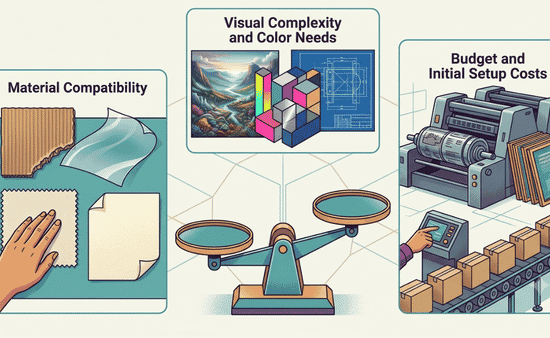
Every large order has distinct requirements. Balancing these three core constraints will point you toward the most logical production choice.
Material Compatibility
The surface you intend to print on dictates your technical limits. Rigid cardboard packaging, flexible plastic film, cotton textiles, and premium textured paper all react differently to ink and heat. A method that delivers flawless clarity on a glossy brochure might fail completely on a synthetic fabric or a corrugated box.
Visual Complexity and Color Needs
Assess the graphic detail of your design. Simple logos with flat, solid blocks of color require a different mechanical approach than high-definition photographs or intricate digital illustrations. If your project demands strict alignment with a specific brand catalog, or specialized metallic and neon hues, you need a process that handles spot colors with absolute precision.
Budget and Initial Setup Costs
High-volume production relies on economies of scale. Certain traditional techniques require a significant upfront investment in time and money to create physical master templates, plates, or screens. However, once that initial setup is complete, the operational cost for every individual impression drops to pennies, making the overall run incredibly cost-effective.
Efficient production planning can also support Eco-Friendly Workplace Practices to Try by reducing material waste, minimizing unnecessary setup changes, and making better use of resources throughout the manufacturing process.
Leading Methods for Bulk Production
Understanding the mechanics of modern industrial production allows you to match your project with the correct facility capabilities.
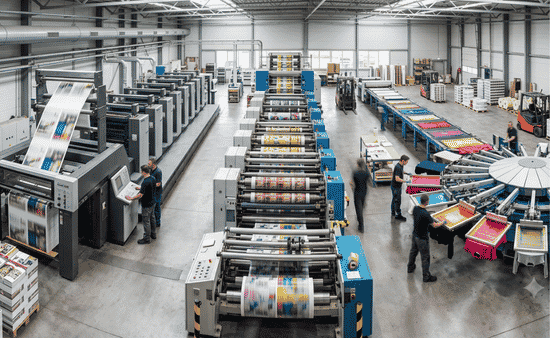
Offset Lithography
For massive paper-based projects like catalogs, books, brochures, and folding cartons, offset lithography remains the industry benchmark. This process utilizes aluminum plates to transfer an inked image onto a rubber blanket, which then rolls the ink onto the paper surface.
While the initial plate creation makes small orders cost-prohibitive, it offers unmatched speed and the lowest per-unit cost for large quantities. It also delivers flawless image crispness and exact corporate color replication.
Flexography
Flexography is the undisputed standard for the high-volume packaging sector. Utilizing flexible photopolymer plates wrapped around rotating cylinders, this process functions like a high-speed rotary stamp.
It is uniquely suited for continuous, rapid printing on diverse, non-porous materials such as plastic bags, food wrappers, cellophane, and corrugated cardboard. Its ability to handle massive web-fed rolls of material at incredible speeds makes it indispensable for consumer goods.
Screen Printing
When your bulk order involves apparel, tote bags, or heavy-duty industrial signage, screen printing is generally the ideal choice. This traditional technique forces thick ink through a stenciled mesh screen directly onto the substrate.
The resulting ink layer is exceptionally vibrant and durable, capable of withstanding repeated washing and outdoor exposure. Because each color requires a dedicated screen setup, this method becomes financially advantageous only when producing identical designs in large batches.
When to Consider Digital Approaches
Digital systems bypass physical plates and screens entirely, transferring digital files directly to ink nozzles or lasers. While digital options are traditionally reserved for short print runs, modern industrial digital presses have evolved significantly.
Industrial digital production is highly effective for large orders requiring variable data, such as unique serial numbers, individual addresses, or customized barcodes on every item. However, for specialized fine art portfolios or limited gallery reproductions where volume is secondary to museum-grade longevity, artists often rely on premium local services like giclee printing in Salt Lake City, Utah rather than mass-production factories.
Final Steps for a Successful Production Run
Before signing off on a massive financial investment, always request a physical pre-production proof from your manufacturing partner. Reviewing a digital proof on a computer screen cannot accurately predict how ink will bond with a physical substrate or how colors will appear under natural light.
Reviewing a tangible sample ensures that the text remains perfectly legible, the graphics align correctly, and the material handles the ink without warping, ensuring your final bulk delivery meets your exact standards.

Ryo Nakamura
View More PostsRyo Nakamura covers gaming news, updates, and industry trends. His writing keeps the community informed about new releases, patches, and competitive shifts, offering clear context and insight into how changes impact gameplay and the broader gaming landscape.